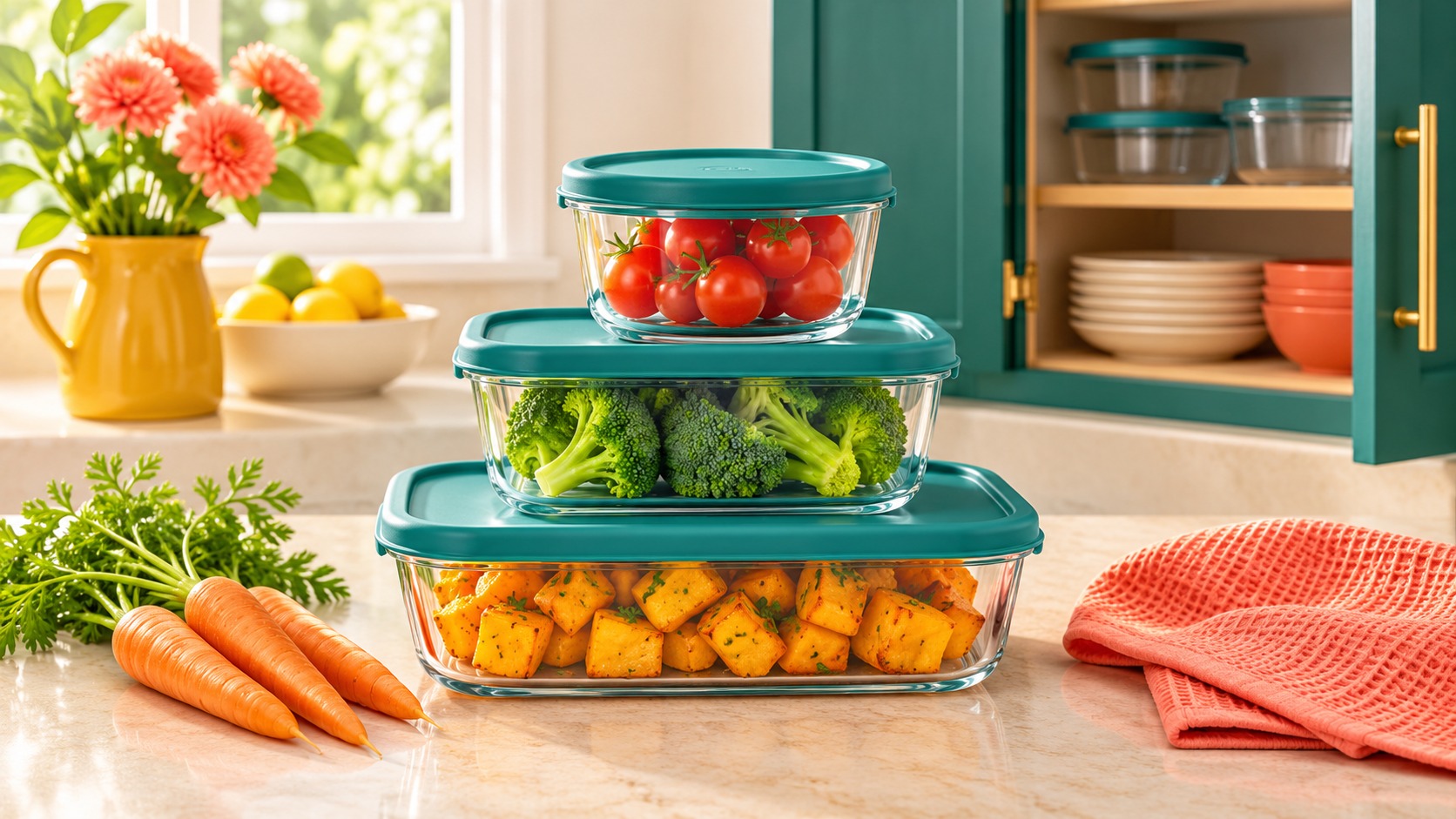
A cupboard full of food containers can still fail at the simplest job: finding a base and lid that belong together. Buying another large set may make that search harder. Before shopping, find out which containers are complete, which sizes you regularly use and where the replacements need to fit.
Choosing food storage containers on a budget is largely a matching exercise. Match capacity to your portions, shape to your shelves and care instructions to the way you plan to use each piece. The useful set is the one you can fill, close, clean and store without rearranging half the kitchen.
Take everything out before adding more
Group the bases with their matching lids. Inspect their condition and follow the manufacturer’s guidance about damage and replacement. Put unidentified or unusable pieces aside so they do not count toward the containers available for everyday use.
Then look at a normal week. Do you pack individual lunches, keep prepared ingredients separate or store a family meal? Count the containers used at the busiest point, not just the ones sitting empty on a quiet morning. This gives you a practical quantity to replace.
Your grocery plan can provide clues. If you usually cook one extra portion, a collection of very large containers may not serve you well. If you regularly divide a shared meal into several portions, a single oversized box may be less useful than a few smaller ones.
Check both capacity and exterior dimensions
A capacity label describes the space inside a container, while exterior dimensions determine where it fits. Read both. Allow for the lid, handles and the clearance needed to remove the container from a crowded shelf.
Measure the cupboard or refrigerator area where you expect to keep it. If a container is for a packed lunch, measure the lunch bag too. A generous capacity is of little help if the lid catches on the bag’s zipper every morning.
Do not assume that containers advertised as stackable will stack neatly with the ones you own. Product ranges can differ in shape, lid profile and footprint. Look for clear measurements or test one piece before committing to a larger collection when that option is available.
Read the piece count carefully
Some sets count each base and each lid as a separate piece. A twelve piece set might therefore contain six complete containers. Other listings use a different convention. Read the contents list instead of comparing the large number on the package.
Next, count only the complete containers you are likely to use. For a hypothetical comparison, Set A costs $24 and includes six bases with six lids. If all six suit your meals, the price is $4 per complete container. Set B costs $18 and contains eight bases with eight lids, but only three are sizes you need. Its useful quantity for your household is three, making the cost $6 per useful container.
That does not make the second set poor value for everyone. It shows why the lower shelf price does not settle the question for your kitchen. Our guide to comparing multipack prices without overbuying explains the same calculation for other household purchases.
Choose around the care routine
Check the instructions for the exact container and lid, including any separate seals or clips. Confirm the permitted uses and temperatures for each component. Do not infer freezer, dishwasher, microwave or oven suitability from appearance, material alone or the presence of a similar product in the same brand.
Think about cleaning as well as storing. A design with several removable parts may be manageable if you intend to take them apart as directed. It may be a poor fit if you want a simpler routine. Check whether replacement lids or seals are available, while remembering that availability and prices can change.
Follow appropriate food handling and storage guidance for what you put inside. An expensive container does not remove those requirements.
Buy for the gap you can name
Write a short list such as “three medium lunch containers that fit the blue lunch bag” or “two shallow containers that fit the middle shelf.” Include a spending limit. That description makes it easier to reject a discounted set of shapes you already struggle to store.
Use our useful clearance shopping list approach if you are comparing sale items. Check the exact quantity, missing components and return terms before adding them to the cart. A partial set may still work, but only when you know what is included.
If you are organizing supplies for someone else to use, keep the containers easy to identify. The same principle appears in our pet sitter supply kit guide: a familiar container with a clear purpose often beats a collection of new accessories.
Keep a small record of what works
After using a new container, note its capacity, the meals it suits and where it fits. Keep the product details with your household shopping notes. If it works well and you later need another, you can compare the actual size rather than start from an uncertain memory.
The goal is a cupboard where the right lid is easy to find and the available containers match your routine. Buy the missing pieces deliberately, and leave the extra set on the shelf until you can explain what it would do.