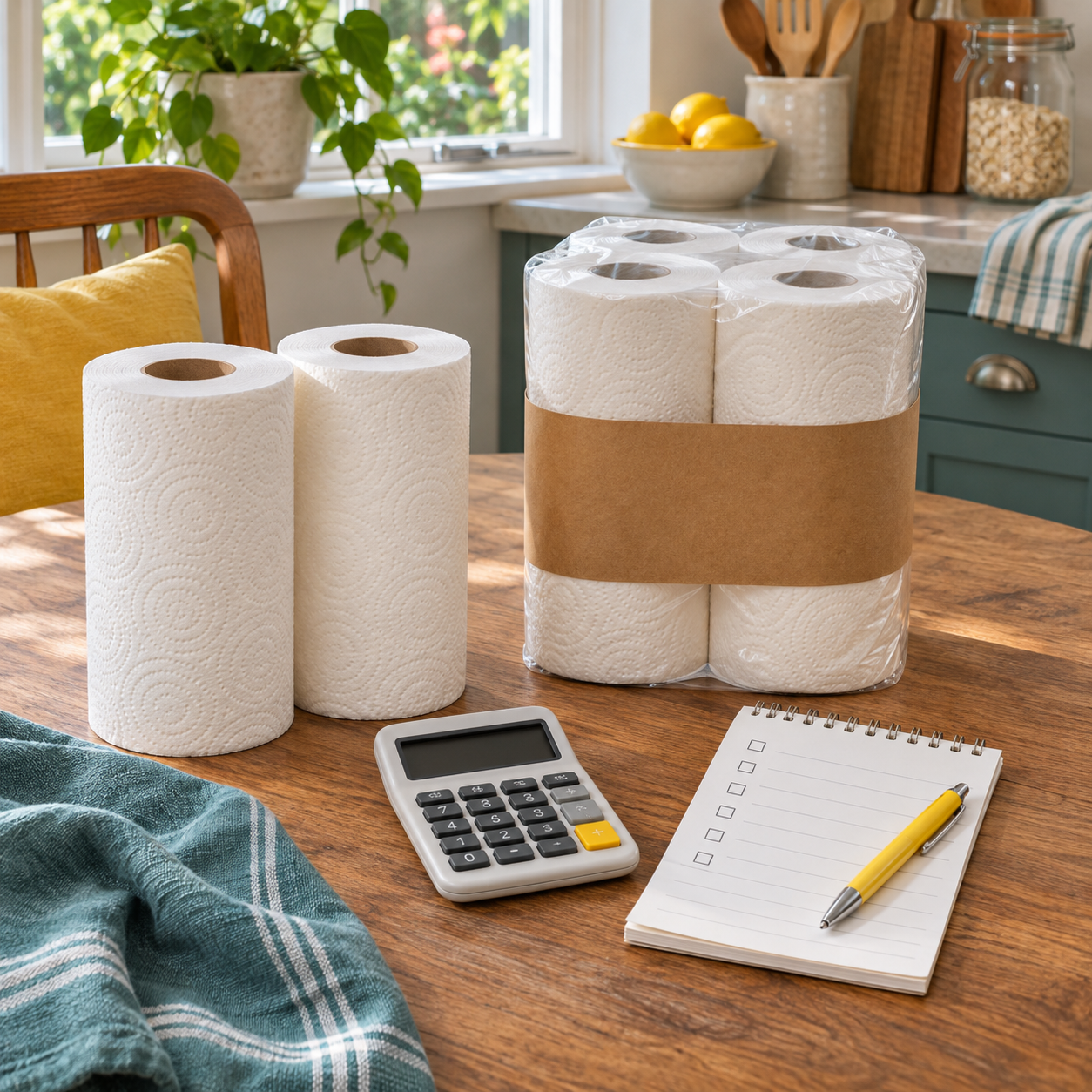
To compare multipack prices fairly, look past the number of items printed on the package. Two packs can contain different bottle sizes, sheet counts or amounts of usable product. The larger-looking option is not automatically the better value.
A useful comparison answers three questions: what does the same quantity cost, how much will your household use and what will the purchase do to this week’s budget? Work through those questions before adding the biggest pack to your cart.
Choose one unit for both packs
Start with the actual quantity on the label. For liquids, compare a common volume such as 100 milliliters or one fluid ounce. For products sold by weight, use the same weight unit. Do not compare the price per bottle with the price per ounce.
With paper products, read both the sheet count and sheet size. “Double” or “jumbo” on the front does not tell you enough on its own. If the products differ in size or performance, a quantity calculation is only part of the decision.
Do the calculation using the total quantity
Divide the pack price by the total quantity, then express both results using the same unit. A phone calculator is enough. Keep the quantities visible so you can check that you have included every bottle or item in the pack.
Here is a hypothetical example using bottles of the same liquid product:
- Pack A contains four 400 mL bottles for $12: 1,600 mL in total.
- Pack B contains two 500 mL bottles for $8: 1,000 mL in total.
- Pack A costs $0.75 per 100 mL.
- Pack B costs $0.80 per 100 mL.
Pack A has the lower unit price, but it also costs $4 more at checkout. If you need only 1,000 mL and do not want to store the rest, Pack B may still be the purchase that fits your plan.
Compare the amount you will actually use
A favorable unit price is less useful when some of the product goes unused. Think about how often your household uses it, whether everyone likes it and whether you already have an unopened supply.
For food, follow the storage and date guidance on the package. For cleaning or personal-care products, check storage instructions and whether the formula suits your needs. A large pack of an unfamiliar product can create more uncertainty than a smaller first purchase.
For a product you use regularly, note roughly how long one container lasts before choosing several months of stock. You do not need a precise forecast; a recent household pattern is more useful than assuming that any quantity will eventually be used. Consider changes such as travel or a move that could affect storage or consumption.
Keep that estimate separate from the promotion deadline. A short sale window can create urgency without changing your household’s needs. If the pack would sit unused for a long time, compare a smaller purchase before deciding whether the apparent saving is useful.
Check the cupboard before buying a backup
Give the pack a destination before bringing it home. Can it sit safely on a shelf? Will it block access to items you use more often? Will you remember where the extras are when the open container runs out?
A quick stock check can prevent duplicate purchases. Our grocery plan that starts in your kitchen uses the same principle: begin with what you already have, then make the shopping list. An organized shelf can be more useful than another backup pack.
Include conditions that change the total
If a coupon applies to only one pack size, calculate the unit price again after the discount. Check minimum spend, quantity limits and whether you need to buy more than one pack to qualify. A discount that requires extra purchases changes the comparison.
For an online order, compare the delivered totals when shipping differs between options. Our guide to comparing the final price can help you keep the basket total separate from the headline saving. Compare similar delivery choices rather than adding faster shipping to only one side.
Set a limit for the upfront spend
You do not have to choose the lowest unit price if doing so strains the current budget. Set the amount you can comfortably spend on household supplies, then compare options within it. Keeping money available for other planned purchases is a valid consideration.
If a promotion adds a second pack, ask whether you would have bought and used it anyway. Our guide to evaluating buy-one-get-one offers walks through that decision. Buying more is useful when it supports an existing need, storage space and spending plan.
Frequently asked questions
Is a multipack always cheaper?
No. Pack sizes, promotions and product quantities differ. Calculate both prices using the same unit before deciding which has the lower cost for an equivalent amount.
Should I trust the shelf unit price?
It is a helpful starting point. Check that both labels use the same unit and reflect the offer you can actually use. Recalculate if a coupon, membership condition or different pack size changes the price.
What if the cheaper pack is too large?
Choose the quantity that fits your likely use, storage and available budget. A smaller pack can be a reasonable choice even when its unit price is slightly higher.