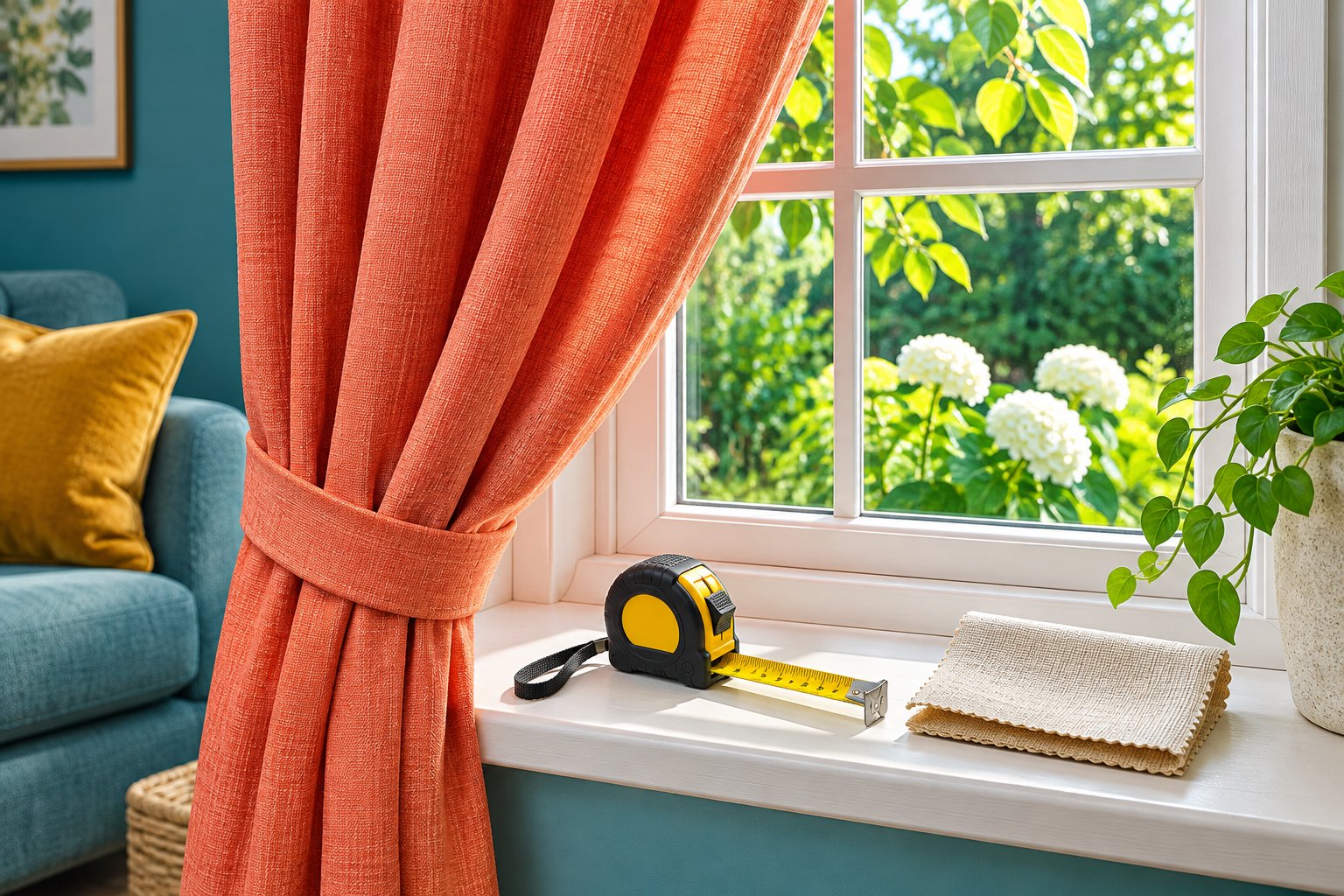
The curtain color can be perfect and the price can be excellent, yet the panels can still leave a gap down the middle or stop awkwardly above the floor. Those are expensive details to discover after you have opened a final sale package.
To measure curtains before buying, record the usable rod or track width, measure the drop from the correct hanging point and check whether the listing price covers one panel or a pair. Then compare your numbers with the exact heading style and fabric you want.
Start with the hardware you will actually use
If you are keeping an existing rod or track, measure the span the curtains will cover. Decorative end pieces are not hanging space. Record the hardware type too: a rod, a track and a tension rod can require different curtain headings or fittings.
If the hardware is not installed, decide on its position before choosing the curtain length. The window opening by itself does not establish the length of fabric you need. Note nearby shelves, furniture, handles and anything else that affects how the curtains will hang.
IKEA’s VIDGA measuring guide starts with window width and then considers the rail extension and mounting position. Its measurements are guidance for that system. Use the instructions for the hardware you are purchasing rather than treating one suggested extension as a rule for every room.
Work out how much fabric the width needs
A curtain panel’s listed width is usually its flat width, not the amount of rod it will cover while looking full. Two panels that add up to exactly the rod width can look much flatter than the product photo.
For some gathered styles, a planning estimate is a combined fabric width around twice the rod width. IKEA also describes fuller arrangements in its window measuring guide. The right amount depends on the fabric, heading and manufacturer’s instructions. Prepleated curtains may already have their fullness built in, so check how their stated width is defined.
Suppose the rod’s usable span is 60 inches and the heading’s instructions recommend twice that amount of fabric. You would be looking for about 120 inches of combined flat panel width. Two panels measuring 60 inches each would meet that example. Two 30 inch panels would not.
Write down both the number of panels and their individual width. “Two panels, each 60 inches wide” is harder to misread than a note that only says “120 inches.” These are sample measurements, not instructions for every heading type.
Measure the length from the right starting point
The starting point changes with the heading. Grommets, rod pockets, tabs and hooks sit differently on their hardware. Read the seller’s measuring instructions and identify exactly where its stated length begins before measuring your room.
Decide where the fabric should end. You might want it near the sill, below it or just above the floor. If you prefer a little clearance, decide how much and use it consistently. Do not choose a standard length first and hope the mounting position will make it work.
Measure the drop at the left, center and right of the area. Floors and mounting points may not be perfectly level. Keep all three numbers and decide how the difference will affect your chosen finish. For custom orders, follow the seller’s instructions about which figure to submit and any allowances they handle themselves.
Count the package contents before comparing prices
A product photo showing two curtains does not prove that two are included. Find the package quantity in the description. Then calculate the price for the entire window, including the number of packages needed.
Imagine Listing A costs $24 for one panel and Listing B costs $42 for a pair. If both options are otherwise suitable and you need two panels, Listing A costs $48 before delivery while Listing B costs $42. The cheaper looking product tile is not the cheaper window.
Our guide to comparing multipack prices uses the same approach: identify the unit, then compare the amount you need. Include rings, hooks or clips only if your chosen heading requires them and they are not already available.
Check care and alterations while the order is still optional
Read the care label information before choosing fabric for a busy room. Consider whether you can manage the cleaning method, whether the product has stated shrinkage allowances and whether shortening it would add a cost.
If hemming is part of the plan, price it before buying. An inexpensive panel that needs paid alterations may cost more than a suitable ready made length. Ask for a fabric sample where available if the color or texture is central to your decision.
Also read the exact return terms for opened, altered and custom items. The clearance shopping checks are especially useful when a discounted panel cannot be returned.
Save this measurement note before you browse
- Room and window name.
- Hardware type and usable width.
- Heading style and its measuring starting point.
- Left, center and right drop measurements.
- Desired endpoint and any clearance.
- Panel width, quantity and total packages needed.
- Maximum delivered cost, including fittings or alterations.
Photograph the existing setup for your own reference and keep this note with your shopping list. Before ordering replacement curtains, you might also try the room refresh guide to decide whether a different arrangement of your current panels would solve the problem.
Should you round a measurement to the nearest standard size?
Record the actual measurement first. Then compare standard options with the finish you want and the seller’s instructions. Rounding too early can hide a gap that no amount of rearranging will fix.
Manufacturer measuring references reviewed November 13, 2026. Hardware and heading instructions vary, so confirm the requirements for your exact curtain system.