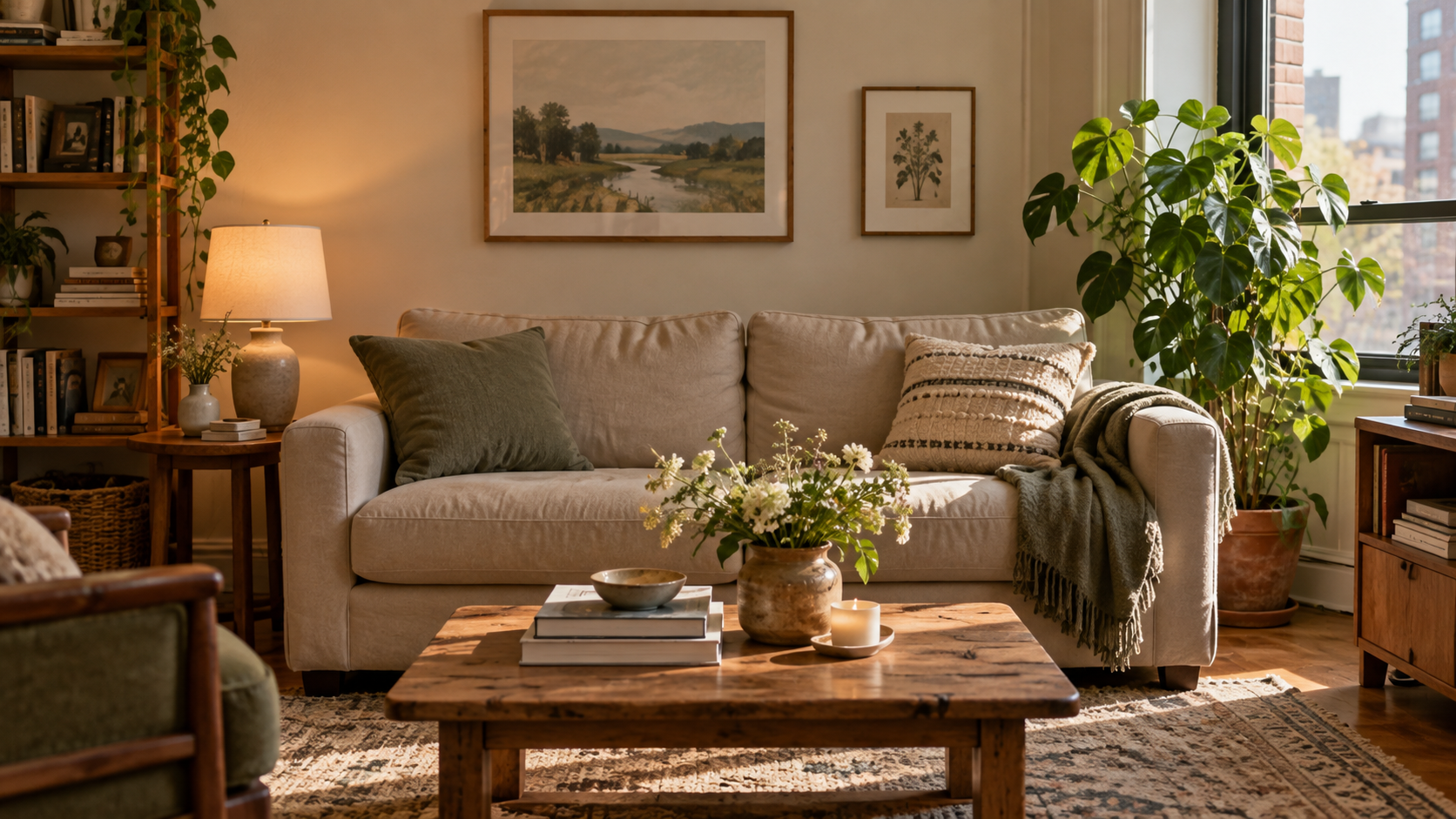
You know the moment: you look around a room, decide it feels a little flat, and immediately start browsing cushions. The room has not explained its problem, but the shopping cart is already trying to solve it.
Pause before ordering. A room can feel different when you change its arrangement, clear a crowded surface, or move something you already own. Try this small reset first. You can still buy a lamp later if you discover you actually need one.
Choose one view, not the entire home
Stand where you usually enter the room and take a photo. Pick the area that bothers you most: the sofa wall, a crowded corner, or the surface beside your bed. Working on one view gives you a clear stopping point.
Ask what feels wrong in plain language. Too crowded? Too empty? Nowhere to put a drink? “Needs to look better” can lead to random purchases. “The side table is covered in things I do not use here” has a simpler answer.
Clear the surface before styling it
Remove everything from one table, shelf, or console. Return the items that serve a purpose there. Put unrelated objects back where they belong rather than transferring the clutter to the next room.
Leave some space empty. You do not need to refill every cleared inch. A surface that can hold a cup or an open book may be more useful than a perfectly arranged collection of decorative objects.
Shop the rooms you already have
Look for an unused basket, a spare cushion cover, a small print, or a throw that lives in the wrong place. Move one or two items into your chosen area and test them there.
Borrow with a little restraint. If your living room improves but your bedroom loses its only reading lamp, you have moved the problem rather than solved it. Keep objects where they are useful, and follow electrical and furniture instructions when moving anything that needs special placement.
Make the layout work for your routine
Think about what you actually do in the room. Can you reach the side table from the seat you use? Is the usual walkway blocked by a basket? Does your evening reading spot have a suitable light?
Small adjustments can answer those questions without a major furniture shuffle. Move a light chair, rotate a small table, or relocate a storage basket if it is safe and practical. Avoid blocking exits, vents, heaters, or doors, and get help with heavy furniture.
Group the useful things
A tray you already own can hold the remote and reading glasses. A basket can give spare throws one home. A stack of books can be arranged neatly instead of scattered across several surfaces.
Do not buy an organizer before knowing what it needs to hold. Measure the space and gather the items first. The attractive box is less impressive when it cannot fit the thing it was bought for.
Take the second photo
Return to your original viewpoint and take another picture. Look at what changed. If the room feels calmer and works better, stop there for a few days. Living with the arrangement will tell you more than another hour of browsing.
If a real gap remains, describe it precisely: a washable cover of a certain size, a table that fits a measured space, or a basket with a lid. Our shop-your-own-wardrobe approach uses the same idea: test what you have before naming what is missing.
A refresh does not need a before-and-after shopping receipt. Sometimes the best improvement is being able to use the room comfortably again.