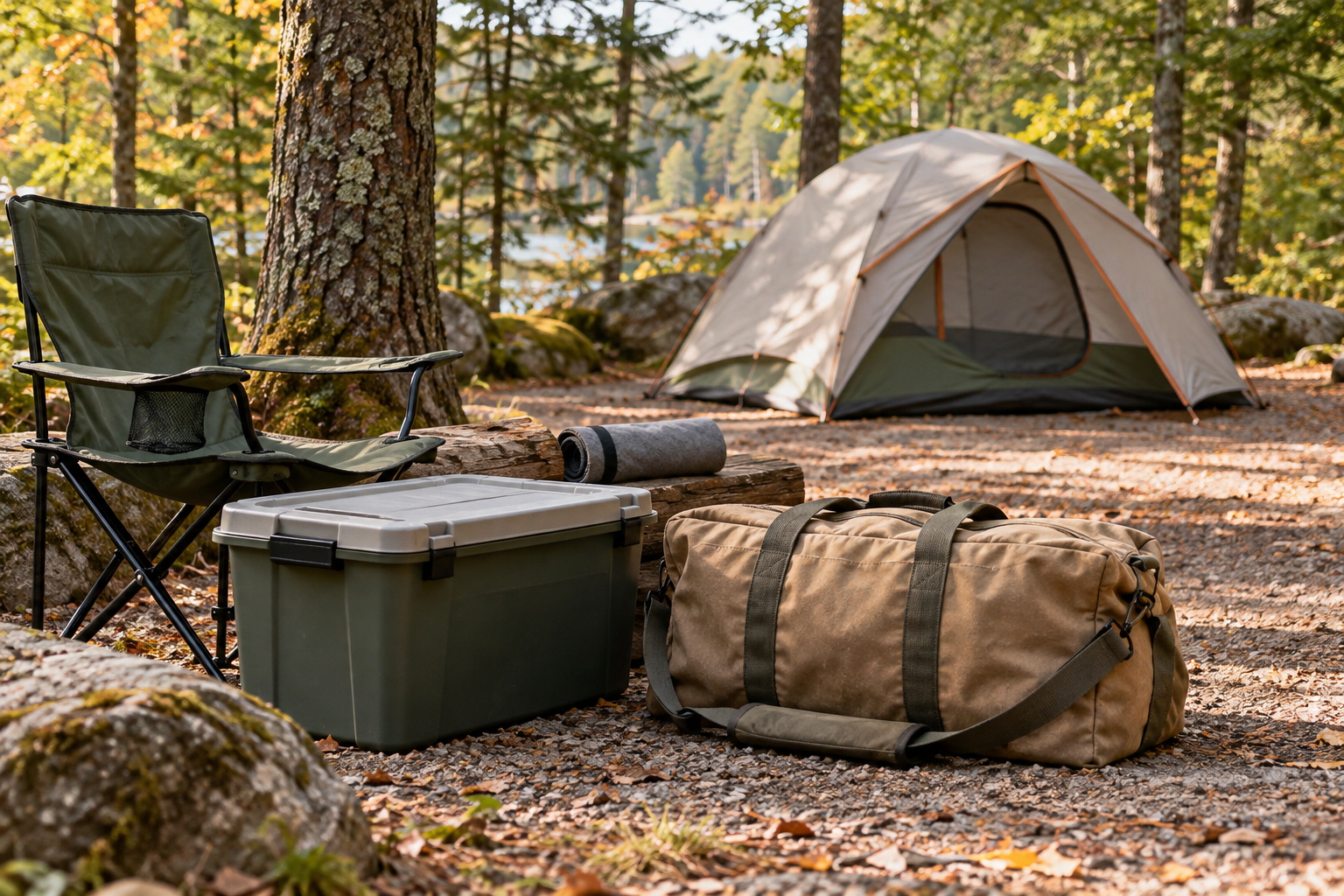
Buying camping gear on a budget starts with a slightly unglamorous question: what kind of trip are you actually taking? A weekend at a campground beside your car calls for a different shopping list than a hike to a remote campsite. If you shop before answering that question, it is easy to pay for lightweight equipment you do not need or bring bulky gear that does not suit the trip. Write down where you are going, how you will get there, and what the site provides before opening a sale page.
For a first trip, the goal is a workable setup that fits the conditions, not a matching collection of equipment. You may already own clothes, bags, and kitchen items that can do part of the job. You may also know someone with a tent or camp chair they would be happy to lend. Put those options on the list before assigning money to anything new. Equipment you use twice a year should earn its place in the budget differently from something you expect to use every month.
Plan camping gear on a budget around the campsite
Read the campground’s information for your dates. Look for details about water, toilets, cooking rules, parking, and any equipment restrictions. Then check the expected conditions and the requirements of the equipment you plan to bring. A photograph of a sunny campsite tells you very little about what a cold or wet night will require. For weather protection and other essential equipment, use the manufacturer’s specifications and appropriate local guidance. A lower price is useful only after the product meets the needs of the trip.
Split your shopping list into equipment you need, equipment you can borrow, and conveniences you can leave at home. A chair might make an evening more comfortable, but it does not deserve the same priority as suitable shelter. That distinction helps when a sale presents all the products as equally urgent. Give the essentials an allowance first, including any required parts. Spend what remains on comfort rather than reducing the essential budget to fit a discounted accessory.
Borrow before buying camping gear on a budget
Borrowing can make a first camping weekend much less expensive, especially for items you are still learning to choose. Ask about the tent’s actual capacity, the condition of the equipment, and whether all its parts are included. Arrange to collect it early enough to assemble it before departure. A borrowed tent with missing poles is not a free solution if you discover the problem at the campsite. Agree on cleaning, return timing, and responsibility for damage so a helpful loan stays straightforward.
Rental is another option where it is available, but compare the complete charge. A daily rate may look appealing until pickup travel, extra days, deposits, or cleaning fees enter the calculation. Use a hypothetical example: renting a $90 item for $20 makes sense for one weekend, but six similar rentals would total $120 before any extra charges. That does not prove buying is always better. It simply gives you a way to compare the expected number of trips with the cost of ownership and storage.
Shop used equipment with a specific inspection list
Used chairs, storage boxes, and some simple accessories can be worth considering when you can inspect them properly. Look for working hinges, secure fasteners, intact fabric, and the parts needed to use the item. With a tent, ask to see it assembled and examine the poles, zippers, floor, and seams. A low asking price should reflect the condition, rather than distract you from it. If the seller cannot identify the model or explain what is missing, allow for that uncertainty before deciding whether it is a bargain.
Replacement parts can change the comparison quickly. A $35 tent that needs $25 in parts and a separate purchase to make it usable is a different proposition from a complete $35 tent. Availability matters as much as price: a discontinued part may be hard to find at any cost. For safety-critical or technical equipment, follow the manufacturer’s guidance on inspection, service life, and secondhand use. This shopping guide is not a substitute for that guidance, and a discount should never be the reason to overlook it.
Read bundles as a list of separate purchases
A starter bundle can simplify shopping, but check every item against your trip list. If a package costs $140 and the two pieces you need are available separately for $100, the remaining accessories are effectively a $40 purchase. They are useful value only if you would have bought them anyway. Look at capacity and specifications for each component instead of assuming the package is coordinated for your needs. A large bundle can still contain a tent that is too small or an accessory that does not fit the rest of your equipment.
Delivery and returns deserve attention because camping purchases can be awkward to send back. Find out whether return shipping is deducted from the refund, whether opened equipment is eligible, and whether clearance changes the rules. Our guide to comparing the final price before buying explains how to put those expenses beside the advertised discount. Compare complete usable setups, not just the cheapest headline price for one component.
Wait on the upgrades you cannot judge yet
When choosing camping gear on a budget, your first trip will tell you more about useful upgrades than an hour of browsing accessories. You may discover that storage organization matters more to you than a larger chair, or that the borrowed tent has plenty of space. Keep a brief note about what was missing and what stayed unused. That gives the next purchase a job to do. It also prevents a sale from deciding that you need a whole new version of an item that worked well.
Buying camping gear on a budget becomes easier when you build the kit over several trips. Cover the requirements of the next outing, borrow or rent where the numbers make sense, and inspect bargains as carefully as full-price purchases. Keep money for the trip itself, including transport and campground charges. A less elaborate equipment collection can still support a good weekend, provided the pieces you take are suitable, complete, and ready before you leave.