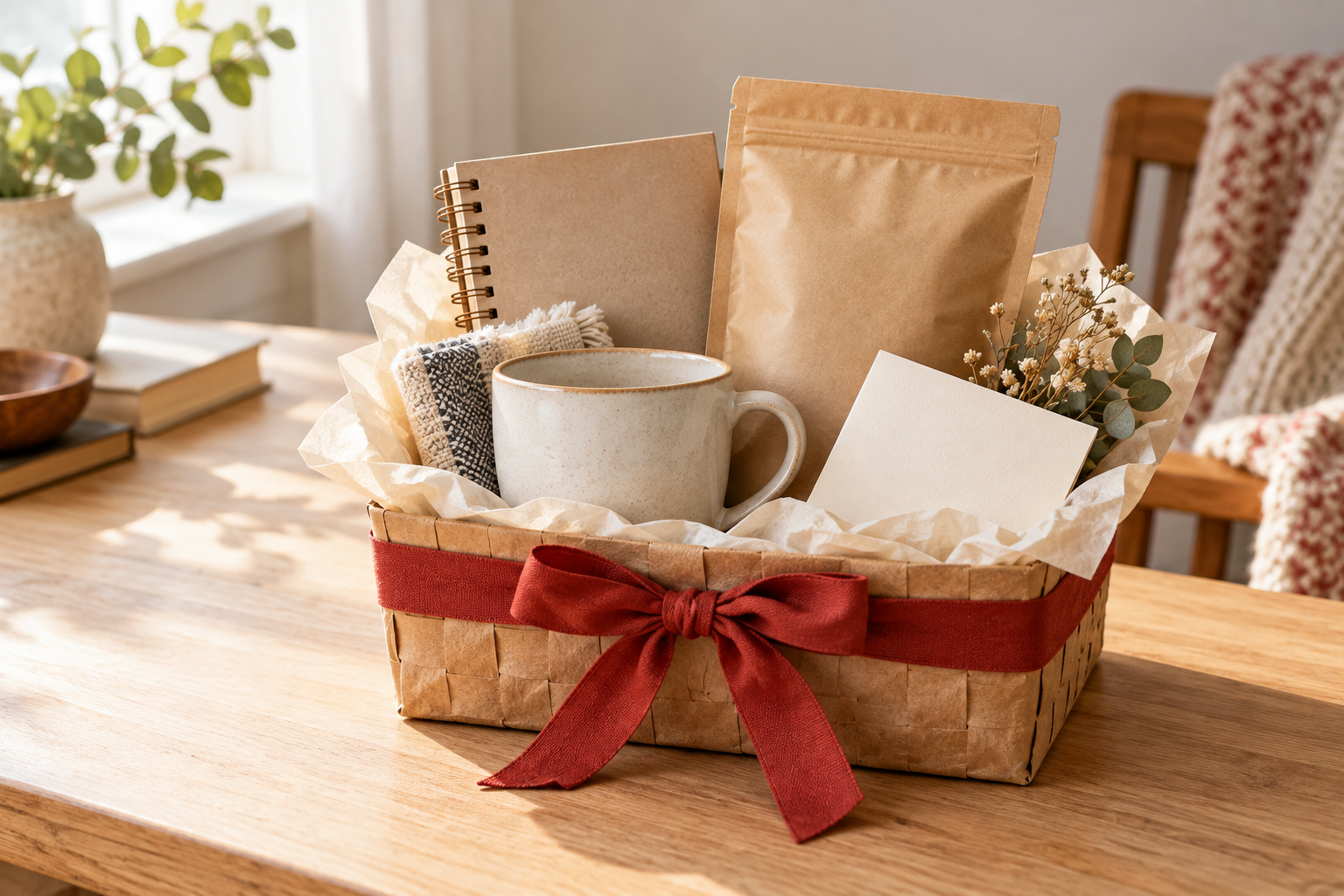
DIY gift baskets can look thoughtful without requiring a cart full of tiny presents. The trick is to build around something the recipient will actually use, then add a couple of items that belong with it. A mug, tea, and a handwritten note make a more coherent gift than six unrelated clearance finds. A $25 limit is enough to put that idea to work, provided you count the container, wrapping, and delivery before choosing the contents.
Start with the person rather than a picture of a finished basket. Someone who makes coffee every morning gives you a useful starting point. So does a friend who keeps a notebook beside the sofa or a relative who is always planning the next movie night. Choose a small part of their routine that you can make more enjoyable. You do not need to invent a new hobby for them or buy enough supplies to fill an oversized basket.
Give DIY gift baskets one main item
Pick the main gift first and spend roughly half your budget on it. That might be a sturdy mug, a paperback from a favorite genre, or a small sketchbook. Then choose one or two companions, leaving room for tax and presentation. The main item should still feel like a complete gift if you remove the extras. This is a useful test when a tempting bag of filler starts taking up more of the budget than the thing you meant to give.
Container size matters more than it seems. A large basket practically asks you to keep shopping until it looks full. A small reusable box, a paper gift bag, or a clean container you already own can make the same contents look finished. Use folded tissue paper to lift the items, rather than buying another product to cover an empty corner. If you are reusing a container, check its condition and remove old labels. The recipient should notice the gift, not the packaging’s previous job.
A tea break theme for DIY gift baskets
For a tea drinker, work backward from a useful mug and a tea you know they enjoy. As an illustrative budget, allow $8 for the mug, $5 for tea, $4 for a packaged treat, and $2 for a small gift bag and tissue. That puts the contents and presentation at $19 before tax, leaving $6 of a $25 budget unspent. These are planning allowances, not quoted store prices. If the mug you choose costs $12 instead, drop the treat or reuse a bag rather than quietly raising the limit.
Keep food in its original sealed packaging so the recipient can check ingredients and dates. A flavored tea assortment is not automatically a good choice for someone who only drinks one particular blend. Likewise, a large bag of sweets adds little value if you do not know whether they can eat it. A brief note explaining why you chose the mug or tea does more personal work than another snack. If the gift must be mailed, choose a less breakable main item and include the postage in your calculation.
A reading night gift without the expensive extras
A reading basket can be as small as a book, a bookmark, and a favorite packaged snack. For example, a $10 book, a $2 bookmark, a $4 snack, and $2 in wrapping would total $18 before tax. A book by a writer the person already likes is a better bet than a decorative reading accessory chosen only because it photographs well. If you do not know what they have read, a small bookstore gift card with a personal note avoids giving them a duplicate. Check the card’s minimum amount before building the rest of the gift around it.
You can also make the container useful by placing the gift in a simple tote you already have in new condition. Resist adding a candle, socks, and a blanket just to reproduce an elaborate gift-guide image. Each extra introduces another preference to get right and another cost to absorb. Three well-chosen items can suggest a relaxed evening just as clearly. Our holiday gift budget guide can help you keep several small gifts within one overall spending limit.
Make a hobby gift small enough to use
For a friend who draws casually, consider a compact sketchbook with a few pencils rather than a huge art kit. An example allowance of $9 for the book, $6 for pencils, and $2 for wrapping comes to $17 before tax. Leave the remaining amount alone unless you find something that improves the gift, such as an eraser the person regularly uses. Someone who already works with professional supplies may have very specific preferences. In that case, ask what they need or choose a gift that supports their routine without trying to replace their equipment.
The same approach works for cooking, gardening, or game nights: buy for a familiar activity and keep the gift focused. A kitchen towel paired with a favorite spice can be enough for a home cook. A scorepad and snacks might suit someone who hosts board games. Avoid buying a specialized tool merely because it is deeply discounted. A bargain loses its appeal when the recipient needs three more purchases before they can use it. Personal does not have to mean complicated.
Keep DIY gift baskets under $25
Before checkout, put every expense in the same total: items, tax, wrapping, and any shipping. Buying the contents from three stores can erase the advantage of a cheaper individual item if each order has a delivery charge. Local pickup or a single planned shopping trip may work better. Check multi-buy offers carefully, too. Two mugs for a lower unit price help only if you have a second recipient. The extra mug still takes money out of this week’s gift budget.
Finish with a short note and stop when the gift feels complete. There is no requirement to spend all $25, and there is no prize for squeezing one more object into the bag. DIY gift baskets work best when the contents show that you noticed what someone enjoys. A useful main gift, a small companion, and a personal message can do that without turning a modest present into an expensive project.